Ledderhose disease, also called plantar fibromatosis, is a condition that causes firm lumps to form in the arch of the foot. While often painless at first, these lumps can become uncomfortable when walking or wearing shoes. The condition is closely linked to Dupuytren’s disease of the hand and is frequently misunderstood or mistaken for plantar fasciitis. This guide explains the symptoms, causes, diagnosis, and treatment options for Ledderhose disease.


I see a lot of patients with Dupuytren’s disease in the hand, and sometimes they also have lumps in their feet but have never been told that the two could be related. Often they have just assumed it is something separate, or something to ignore.
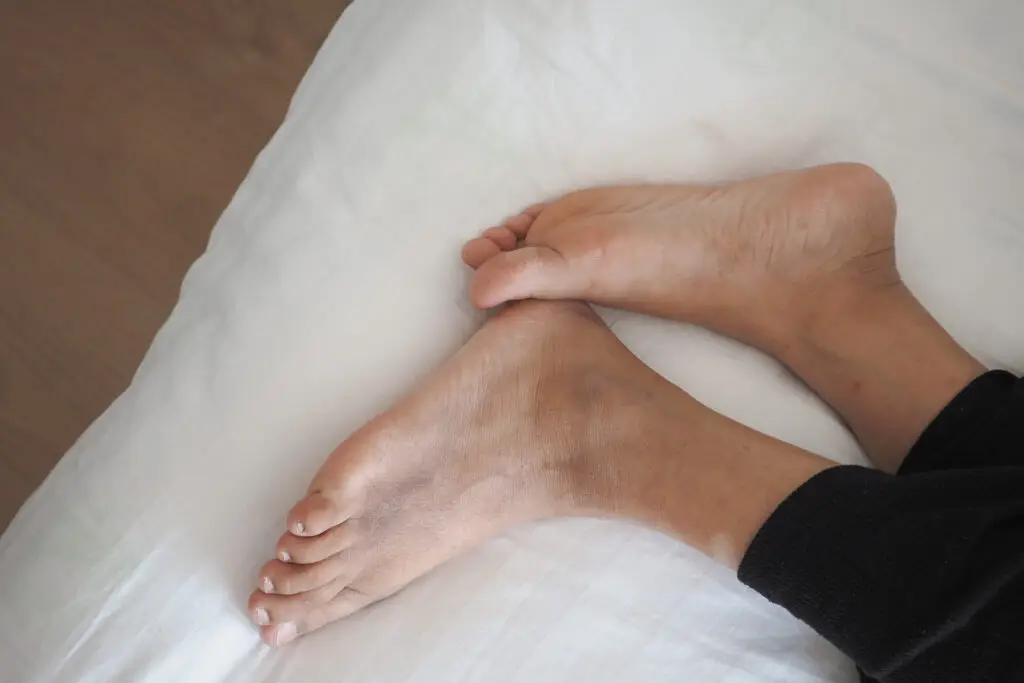
Ledderhose disease is the name given to a condition causing firm lumps in the arch on the sole of the foot which can become uncomfortable and interfere with walking or wearing certain types of shoes.
What is Ledderhose disease?
Ledderhose disease, also known as plantar fibromatosis, affects the layer of tissue just underneath the skin on the sole of the foot. This tissue is called the plantar fascia, and it runs along the arch of the foot.
In this condition, small lumps form within that layer of tissue. These are usually found in the arch rather than the heel or toes, and they tend to feel firm and fixed rather than soft or mobile.
Early on, many people have no symptoms at all. They may only notice the lump when it becomes more prominent, for example when walking barefoot or when the skin catches the light in a certain way. Over time, however, the lumps can become more noticeable or uncomfortable.
What do the lumps look and feel like?
The most typical feature is a firm lump in the arch of the foot. People often describe it as feeling similar to a Dupuytren’s lump in the hand, but deeper and less visible because of the thicker skin on the sole.
These lumps are usually easier to feel than to see. A useful way to detect them is to lightly move your fingertip across the skin and feel for any areas of thickening, rather than pressing directly down. Pressing on the lump is less helpful for detecting it, but it can bring out tenderness.
The main symptom is discomfort or pain. This may be felt when standing, walking, running, or at rest. It can also make certain shoes uncomfortable if they press directly onto the lump.
Some people have a single lump, while others have several, and they may occur in one or both feet.
How does Ledderhose compare to Dupuytren’s in the hand?
Ledderhose disease behaves differently from Dupuytren’s in the hand.
In Dupuytren’s, the condition often starts with lumps in the palm which can extend as thicker bands into the fingers and eventually lead to fixed bending of the fingers. In the foot, the process usually remains as lumps within the plantar fascia, and it is very rare for it to cause tightening of the toes. One likely reason is that we are constantly standing and walking, which stretches the plantar fascia, whereas the fingers are often in a more flexed position during daily activities and at rest.
The main issue is also different. In the foot, the problem is usually discomfort from the lumps and how they are affected by pressure. In the hand, the more significant issue for most people is the development of contracture over time.
How does Ledderhose disease change over time?
What patients tend to notice over time is that a lump that was initially painless may start to feel uncomfortable when walking, or a small lump may slowly increase in size.
In some cases, the lump can be quite tender for the first two to three months and then settle down again. For this reason, we do not usually rush into treatment in the very early stages, and simple measures to reduce pressure are often enough during that time.
For some people, the lumps remain stable and never cause significant problems. For others, they grow or remain uncomfortable, and this is what leads to symptoms that interfere with standing, walking, running, or wearing certain types of shoes.
Expert Non-Invasive Treatment for Dupuytren’s and Ledderhose Disease Across the UK
Dr Richard Shaffer set up Dupuytren’s UK in April 2011 to provide non-invasive treatments for people who suffer from benign conditions such as Ledderhose disease and early-stage Dupuytren’s contracture in the Guildford area. Today, Dupuytren’s UK offers this service to patients throughout the UK.

Why does it tend to cause discomfort?
The lumps sit in an area that takes weight every time you stand or walk. This means that the lump is repeatedly pressed on, which can cause tenderness.
The tissue itself can also be sensitive, particularly in the earlier stages. The combination of this sensitivity and repeated pressure is what leads to discomfort.
In the hand, while lumps can sometimes be tender, the bigger issue for most people is that the disease can extend into the fingers and lead to contracture over time, making it difficult to straighten the fingers fully.
How is Ledderhose related to Dupuytren’s disease?
The two conditions are closely related, and they often occur together.
If you have Dupuytren’s disease in the hand, there is roughly a 15 to 20 percent chance that you may also develop Ledderhose disease in the foot. Some patients have both, while others only ever develop one of the conditions.
There is often a genetic component, so you may have family members with Dupuytren’s, Ledderhose, or both, although this is not always the case. Not everyone who has the underlying tendency develops symptoms.
Who tends to get Ledderhose disease?
Ledderhose disease most often develops in people in their 40s and 50s, although it can occur earlier or later.
As with Dupuytren’s, there is likely to be a strong genetic component, but other factors are also associated with the condition. These include diabetes, smoking, alcohol, and previous injury to the foot.
For most people, it is a combination of underlying tendency and these additional factors rather than a single clear cause.
How is it diagnosed?
Your doctor can generally confirm the diagnosis simply by examining you. The look and feel of the lumps in the arch of the foot are often characteristic, and in most cases this is enough to make the diagnosis.
Occasionally, there may be some doubt about what a lump is, for instance if there is only a single lump and nothing in the other foot or in the hands, or if there is something unusual about the lump. In those situations, scans such as ultrasound or MRI may be used to clarify the diagnosis.
It is also common for your doctor to examine your hands at the same time, as the presence of Dupuytren’s disease can support the diagnosis.
How is it different from plantar fasciitis?
This is a common source of confusion.
Plantar fasciitis is caused by strain of the plantar fascia, and this can lead to inflammation and pain in the heel, especially when taking the first steps in the morning.
Ledderhose disease, by contrast, involves lumps within the fascia itself. The discomfort is usually localised to the lump in the arch rather than the heel, and it is related to pressure on that specific area.
What can you do about it?
For some patients, relieving pressure on the lumps is enough to control symptoms. This might involve modifying footwear, using softer insoles, or avoiding direct pressure on the area.
Others may have lumps that do not cause any symptoms at all and do not need any treatment.
However, some patients will find that the lumps grow or remain uncomfortable, and this can start to interfere with normal activities such as walking, exercise, or work. It is also worth knowing that you do not need to wait until the discomfort becomes severe before considering treatment. Even relatively mild discomfort can affect day-to-day function, and because radiotherapy works slowly, it is often better to assess things earlier rather than later.
One treatment that should generally be avoided is surgery to remove individual lumps. What often happens is that the lump comes back, additional lumps develop around the area, and painful scar tissue forms. I see a number of patients who regret having had lumps removed for this reason, as they end up worse than before.
In summary
Ledderhose disease is a benign condition that causes firm lumps to develop in the arch of the foot. These lumps may be painless at first but can become uncomfortable over time, particularly with pressure from standing, walking, or footwear.
It is closely related to Dupuytren’s disease, and the two conditions often occur together, although not always. In the foot, the main issue is usually discomfort and how it affects walking, whereas in the hand the main concern is the development of contracture over time.
If you think you may have Ledderhose disease and want a clear diagnosis and advice on what to do, the most useful step is to be assessed by someone experienced in the condition. That allows you to confirm what it is, understand how it is behaving, and decide whether you need to consider treatment now or at a later date.