
Dupuytren’s Treatment In The UK
Dupuytren’s disease (Dupuytren’s contracture) is a benign condition where the tissue under the skin of your palm thickens. It often starts as a small lump or nodule. For some people, it gradually causes your finger to bend towards your palm. Different treatments are available for different stages. Low-dose radiotherapy is a non-surgical option during the early stages while the disease is still developing.
Many patients with hand symptoms are told to come back when their finger bends. At Dupuytren’s UK, Dr Richard Shaffer can look at your hand, explain where you are and tell you honestly whether treatment, monitoring or waiting makes the most sense.


Where Are You On The Dupuytren’s Journey?
Dupuytren’s disease develops at different speeds in different people. Some might notice a small lump that barely changes for years, while others might experience new nodules, then a cord, then difficulty straightening their finger. Knowing how far your Dupuytren’s has progressed is the first step in choosing a suitable treatment. You may also hear Dupuytren’s called Viking disease or palmar fibromatosis. These all refer to the same condition.
“I’ve Found A Lump In My Palm.”
This is a nodule: a firm lump, most often at the base of your ring or little finger. It is usually painless. Itching, tenderness or recent growth may be signs that the disease is active. Specialists may recommend assessing and monitoring the nodule at this stage, and sometimes radiotherapy if it is changing.
“Things Seem To Be Getting Worse.”
You may notice that a cord or band has formed under your skin from your palm towards your finger. Your fingers still straighten fully or almost fully. Radiotherapy can be an option to consider at this stage.
“My finger is starting to bend” or “I can’t straighten my finger.”
This describes contracture, where your fingers are pulled into a bent position. Treatment options at this later stage may include needle treatment or surgery, as radiotherapy can be less suitable once your finger has bent significantly.
Nodule or callus?
A callus is part of the skin, so you can pinch and lift it with the skin. A Dupuytren’s nodule is fixed underneath and will not lift.
The tabletop test (check at home)
Rest your palm flat on a table and try to lay your whole hand down with your fingers straight.
If your whole hand can make full contact with the tabletop, you have not reached the contracture stage, even if you can feel hard lumps or cords in your palm.
If part of your hand or a finger cannot lie flat on the table, a contracture has usually begun.
The tabletop test is a self-check, not a diagnosis. To keep track of any changes, you can photograph your hand and repeat the test every few months.
You may also hear Dupuytren’s called Viking disease or palmar fibromatosis. These all refer to the same condition.
Not sure where your symptoms fit? Dr Shaffer can tell you in a consultation.
Dupuytren’s Contracture Treatment Options In The UK
No treatment can permanently cure Dupuytren’s disease. Instead, Dupuytren’s treatments aim to slow down the disease or straighten a finger that has bent. The most suitable option for you will largely depend on your stage. Radiotherapy is aimed at early, changing disease. Needle treatment and surgery are used for fingers that have already bent.
| Option | Stage it suits | What it typically involves | Typical recovery | Availability in the UK |
|---|---|---|---|---|
| Monitoring | Early symptoms, like a small nodule and no bent finger | Monitor every 2 months, tracking the results with photos, and review if anything changes | None | NHS and private |
| Low-dose radiotherapy | Early disease that is still changing, with fingers that partially or fully straighten | A short course of outpatient appointments, a few minutes each, using low-energy X-rays. No anaesthetic and no incision | Most people carry on with normal activities | Mainly private |
| Needle aponeurotomy (needle fasciotomy) | A bent finger with a clear cord | Local anaesthetic is applied, and a fine needle is used to divide the cord. The procedure is quick, but the cord can return, so it may need repeating | A few days | NHS and private |
| Collagenase injection | A bent finger with a clear cord | An enzyme injection to weaken the cord. It is often mentioned on overseas websites | Not applicable | Not currently available in the UK |
| Fasciectomy (surgery) | A significant finger bend that affects your daily life | An operation to remove the diseased tissue. A skin graft is sometimes needed | 6-8 weeks, with hand therapy | NHS and private |
What Does Not Help
There is no good evidence that stretching, massage, splints on their own or supplements can change your symptoms or stop Dupuytren’s from progressing. Do not try to pull your finger straight. Forcing it creates strain, which can irritate the tissue and make the condition progress faster.
One Reassurance
Having radiotherapy does not rule out needle treatment or surgery later.
Not Sure Which Fits You?
Radiotherapy For Early Dupuytren’s Disease
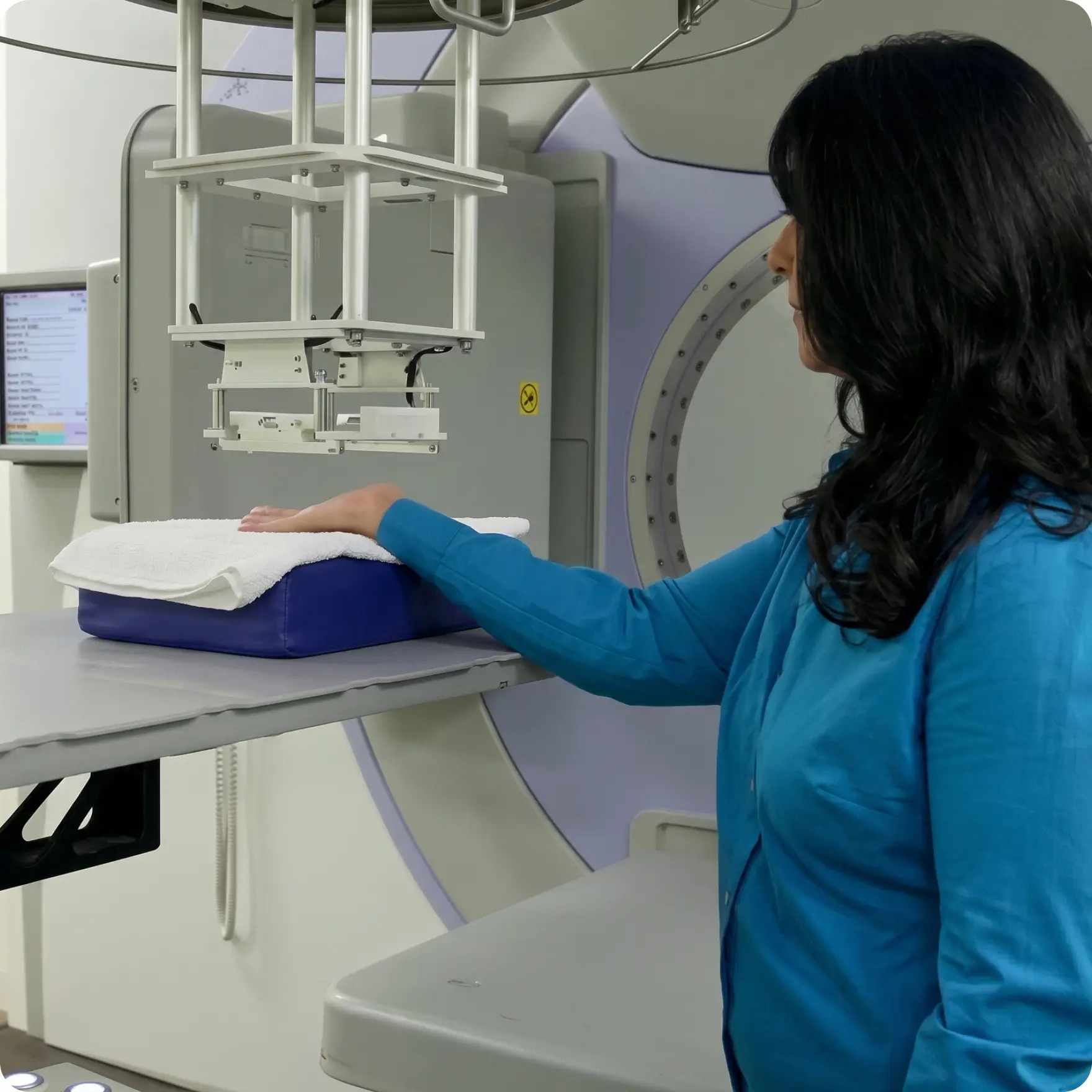
Low-dose radiotherapy uses carefully targeted, low-dose X-rays to calm the tissue changes behind early Dupuytren’s. It is designed to stop the disease from getting worse. It does not straighten a finger that has already bent.
What makes treatment most worthwhile:
Nodules in your palm These are the firm lumps that often appear first. You don't need to have cords.
Fingers that can still straighten, or almost straighten This is essential. Radiotherapy works best before a finger starts to bend.
New lumps appearing in your palm or elsewhere in your hand
Existing lumps getting bigger
Radiotherapy is generally not suitable once a significant contracture has developed.
What Treatment Involves
What The Evidence Says
Why Timing Matters

Your Consultation Is With Dr Richard Shaffer
Dr Richard Shaffer is a Consultant Clinical Oncologist who has treated around 3,500 patients with benign conditions, including Dupuytren’s and Ledderhose disease. He also trains other consultants in radiotherapy for benign conditions.
Dr Shaffer set up Dupuytren’s UK to offer non-surgical care to people with early Dupuytren’s and Ledderhose disease, who are often told there is nothing to be done until their finger bends.
During your appointment, he will examine your hand, assess your symptoms and explain your available options. He can advise you honestly on whether radiotherapy, surgery, or simple monitoring are best for you at your specific stage.
What Happens When You Get In Touch
Getting started is simple, and you do not need to have it all worked out first.

Patients In Their Own Words
These stories reflect individual experiences, and results vary from person to person. They are here so you can hear what the process felt like for people in a similar position.

NHS, Private Insurance And Self-Pay
Dupuytren’s treatments usually only become available through the NHS once your finger has bent enough to affect your daily life. Available treatments usually involve needle treatment or surgery. During earlier stages, it does mean that your symptoms will usually be monitored rather than treated.
On the NHS: Radiotherapy for early Dupuytren’s is not widely available, so most people who choose this option pay privately. That does not affect your NHS care: you can stay with your GP or hand surgeon and have further NHS treatment later if you need it.
With private medical insurance: Bupa, Vitality and WPA generally fund radiotherapy for Dupuytren’s, depending on your policy. AXA and Aviva do not currently cover it for Dupuytren’s, although Aviva does cover it for Ledderhose disease.
Whichever insurer you’re with, the first step is to get authorisation for your initial consultation. Once you’ve seen Dr Shaffer, we’ll talk you through how your treatment is funded.
If you are paying yourself: We can give you a quote for your treatment before you commit to anything. Contact us for an estimate.


Where You Will Be Seen And Treated
Dr Shaffer sees patients for consultations in London, Guildford, Nottingham and Manchester. He prefers to see everyone face to face, because examining your hand gives him the best basis for advising you.
Once treatment is agreed, it can be done at any of our 16 centres across the UK, so you can choose whichever suits you best. Find your nearest centre below.
Video consultations are only offered in exceptional cases, such as for patients based overseas.
It is harder to assess your hand and plan treatment that way, so please talk to us first if you can’t travel.
Dupuytren’s Treatment: Your Questions Answered
Can Dupuytren’s contracture be treated without surgery?
Yes, if it is caught early. Low-dose radiotherapy is often suitable early on when your Dupuytren’s symptoms are still changing.
Once your finger has bent (contracture), your specialist may recommend needle treatment or surgery, because radiotherapy will not straighten an advanced contracture.
If you have a small, stable lump or nodule, you may only need to monitor your hand.
Can Dupuytren’s disease be cured?
No, there is currently no cure for Dupuytren’s disease. What treatment can do depends on the stage you’re at. Radiotherapy is used in the early stage, while your fingers can still straighten or almost straighten. It aims to stop nodules and cords from getting worse, which helps prevent a contracture developing and may mean you never need surgery. Treatments such as surgery and needle treatment aim to straighten a finger that has already bent.
Does Dupuytren’s always get worse?
No, Dupuytren’s doesn’t always develop further once you first notice a nodule. Some people have a small lump that hardly changes for years. It’s worth talking to a specialist if you notice new growth, tenderness and itching in the area. These can suggest that the disease is active and more likely to progress.
When should I see a specialist?
A specialist assessment is worthwhile if your lump is growing, new lumps appear, or your finger has started to bend. Getting advice early on often leaves you with more potential options for treatment. Not every early case needs treatment, and Dr Shaffer will tell you if it’s better to simply monitor your symptoms.
What is the best treatment for Dupuytren’s contracture?
There is no single best treatment. The most suitable choice for you will depend on your stage, how quickly the disease is changing and what you have already tried. Dr Shaffer can assess you during a consultation and talk you through which options might be appropriate for you.
Is radiotherapy for Dupuytren’s safe?
Yes. NICE’s national guidance found no major safety concerns with radiotherapy for early Dupuytren’s disease. The treatment uses targeted, low-dose radiation focused purely on the affected tissue in your hand. Most people experience only temporary skin redness or dryness afterwards. Like any radiation treatment, there is an extremely small theoretical long-term risk, which Dr Shaffer will discuss with you during your consultation. Read more about radiotherapy safety.
Is Dupuytren’s treatment available on the NHS?
The NHS usually treats Dupuytren’s with needle treatment or surgery once your finger has bent enough to affect your daily life. Radiotherapy for early disease is not widely available on the NHS, so most people have it privately. Find out why.
Do I need a GP referral?
It depends on how you’re paying for your care. If you’re paying for yourself, you don’t need a referral. You can enquire or book an initial consultation directly with Dr Shaffer. If you’re using private medical insurance, you will often need a GP referral to get your consultation authorised, although this varies between insurers. It’s worth checking with your insurer before you book. If you’re already seeing a hand surgeon or another specialist, we’re happy to coordinate with them.
Can I still have surgery after radiotherapy?
Yes. Having low-dose radiotherapy does not prevent you from having needle treatment or surgery later if you need them.
Why is Dupuytren’s called Viking disease?
Dupuytren’s disease is more common in people with Northern European ancestry, which fits with historical Norse settlement. However, genetic research suggests the condition has much older roots and can affect anyone regardless of their ancestry. Read the full story.