Early Dupuytren’s disease can be unpredictable—some cases remain stable, while others progress. This guide explains how to recognise changes, when to monitor, and when radiotherapy may be the right option to prevent worsening symptoms.


Finding a lump in your palm can be unsettling. Many people are told to wait until the fingers bend forward to form contractures and then have surgery to release them. For many people that just doesn’t sit well. People want to understand what is happening now and think about whether they need to do something active at this stage rather than waiting until they are finding it difficult to use their hand and then have to consider invasive surgery.
But actually what happens with “early” Dupuytren’s disease is varies massively between different people. In some people the disease stays stable for many years. In others the disease gets worse, either gradually or more quickly. So at the early stage the decision is whether to treat or not, but understanding when the best time to consider treatment is. Perhaps just as importantly, there is also a question about if you’re not having treatment at the moment, what should you be doing in the meantime.
First Step: Are You Sure It’s Dupuytren’s?
Before thinking about any type of treatment, you need to be sure that you actually have Dupuytren’s disease in the first place. Most of the time this is straightforward. Dupuytren’s has a typical pattern, and an experienced clinician can often recognise it just by examining your hand.
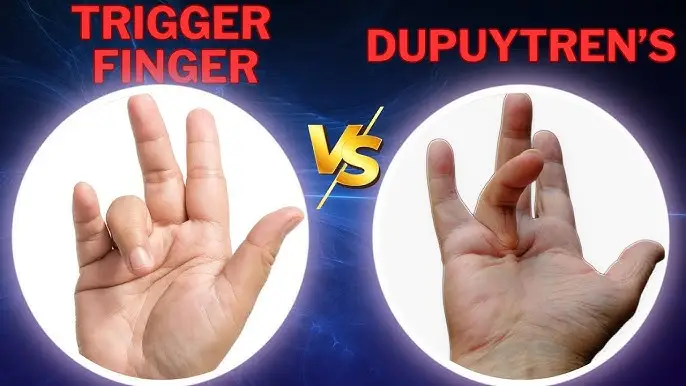
But not every lump in the palm is Dupuytren’s disease. For instance, there are other things like small inflammatory nodules from trigger finger or ganglions cysts that can cause lumps in the same place in the hand.
If there is any doubt, it is worth seeing a doctor with experience in early Dupuytren’s disease. An ultrasound scan can sometimes help, but this is not usually needed. Most of the time, a careful clinical assessment is enough. The important thing is to be clear about what you are dealing with before making any decisions
What Does “Early Dupuytren’s” Actually Mean?
Early Dupuytren’s doesn’t describe one fixed stage. It covers a range, from very early changes that may never need treatment, through to disease that is still technically “early” but already progressing and really needs some sort of intervention.
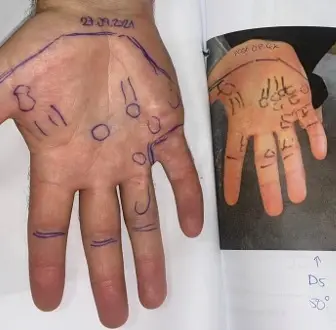
You might have a single small nodule and nothing else. Or you might have nodules with early cords forming and tightening in the hand. Both can be described as “early” Dupuytren’s, but they are clearly not the same and they will need a different approach.
This is why the decision is not based simply on what nodules and cords you have in the palm and fingers, but on what the condition is doing. The two key questions are:
- Is it changing?
- Is it affecting function?
These are not always obvious. Changes can be slow, and early loss of function is often subtle. Many people feel that their hand works normally, but when you examine it more closely, there can already be small changes in how far the fingers go backwards or how well the fingers spread.
Expert Non-Invasive Treatment for Dupuytren’s and Ledderhose Disease Across the UK
Dr Richard Shaffer set up Dupuytren’s UK in April 2011 to provide non-invasive treatments for people who suffer from benign conditions such as Ledderhose disease and early-stage Dupuytren’s contracture in the Guildford area. Today, Dupuytren’s UK offers this service to patients throughout the UK.

The Key Decision: Keep an Eye on It or Consider Treatment
Once the diagnosis is clear, the next step is deciding what to do. In very early cases, with one or two nodules, no cords, and no change in function, the right approach is usually to keep a close eye on things rather than treat straight away.
But the idea is not just to wait. The aim is to track how things change so that you don’t miss the window of opportunity for treatment, but you also avoid treating unnecessarily. In practice, that means paying attention to four main areas:
- The extent of the disease (what you can see and feel) – nodules, cords, and any skin dimpling.
- Symptoms (what you feel) – such as redness, itching, tenderness, or a sense that the area is becoming more active.
- Loss of backward movement – reduced ability to bend the fingers back.
- Hand span – whether the fingers can still spread fully.
Following these over time helps you answer the key question: Is anything actually changing?
If there is clear progression, the situation shifts. This might mean nodules getting larger, new areas appearing, cords extending towards the fingers, or early signs that movement is becoming restricted. At this stage, particularly if there is still no contracture, radiotherapy can be considered as a way of slowing or stopping further progression.
The ideal time for radiotherapy is when the disease is active but before the fingers have started to bend forwards. It can still be used when there is a very small contracture of up to 10 or 20 degrees, but it tends to be less effective, which is why we aim to treat before there’s any contracture at all.
If the fingers are already clearly quite bent, typically around 30 degrees or more, the situation is different. At that point, the problem is mechanical. The tissues have tightened enough to pull the finger into a fixed position, and this usually requires a mechanical solution such as surgery to release it.
Who Is Suitable for Radiotherapy?
Radiotherapy is most useful when the disease is active and progressing, especially if cords are forming and extending towards the fingers, or if there are early signs, even if they’re very subtle, of reduced finger movement.
Sometimes other factors may support the decision. For example people who are younger, have a strong family history of Dupuytren’s, or where both hands are involved, may be more likely to notice progression over time. Also, if you have specialised hand use, for instance in musicians, it may be that we decide to treat you earlier as musicians tend to be more sensitive to small changes in hand function than non-musicians.
On the other hand, if the condition is very recent, limited to one or two nodules, and not changing, radiotherapy is usually not appropriate. The same applies if it’s not clear what the diagnosis is. In these situations, we would just monitor you carefully.
The key point is that treatment is not just based on whether there’s a lump there or not – it’s more about whether the disease is active and starting to affect the hand.
Common Pitfalls to Avoid
One common issue is having treatment too early in the course of the disease. If a nodule has only been present for a short time and there is no clear change, treatment tends not to be necessary at that point.
Another is leaving things too late. Once a significant contracture has developed, the opportunity for non-invasive radiotherapy treatment will have passed, and you would need to consider more invasive surgical treatments.
It is also important to be sure that you definitely have Dupuytren’s disease. Other conditions can look similar, and a proper assessment helps ensure that the right condition is being managed in the right way.
Finally, slow and gradual progression can be easy to miss. This is why simply being told to “watch and wait” isn’t always so helpful. What matters is having a clear plan as to what to look out for and what to do if notice a change.
Getting the Timing Right
Not all early Dupuytren’s needs treatment. Many cases can be observed safely, and some will never progress to the point where any treatment is required.
However, you do need a clear plan that includes understanding the current status of your condition, how to monitor for change, and what to do if you notice change. Saying “not now” does not mean “never” – it just means that if treatment is needed, it should be given at the right time.
If you have noticed a lump or any changes in your hand, it is worth getting it assessed properly. A clear diagnosis and a structured plan, whether that is careful monitoring or consideration of radiotherapy, will help you stay in control of the situation and make the right decisions as things change.