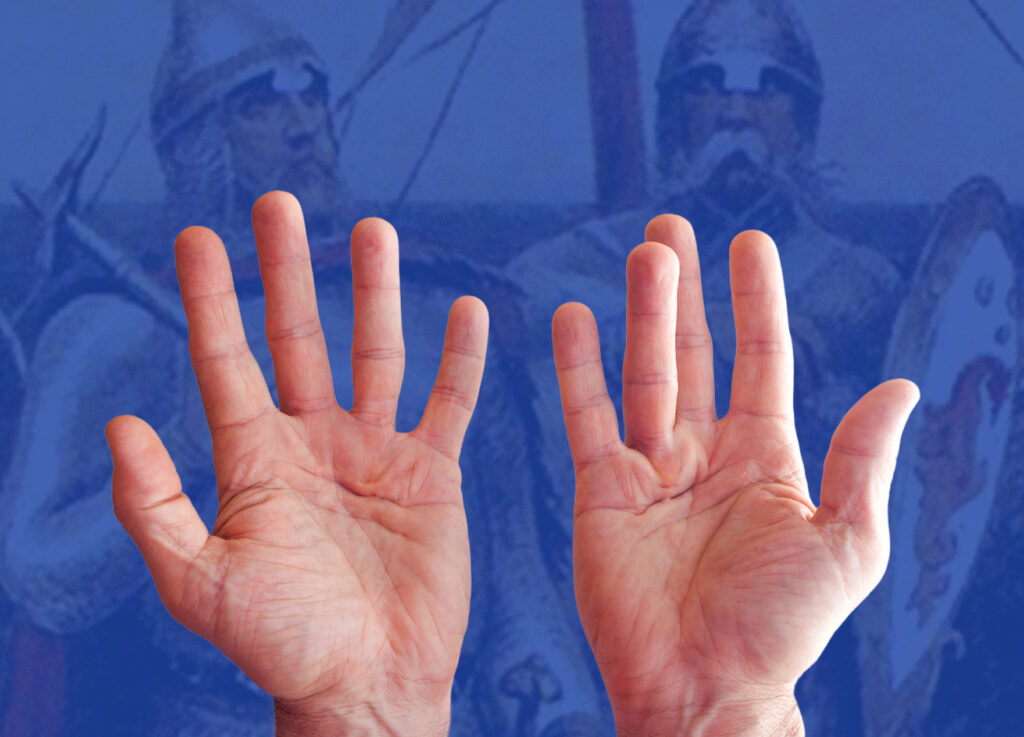
Doctors use a system called Tubiana staging to describe the degree of finger contracture. The stage can help guide treatment decisions, particularly when considering whether someone may benefit from radiotherapy or surgery.
However, Tubiana staging only measures how much the fingers have bent. Other changes in the hand can be just as important when deciding whether treatment is needed.
How does Dupuytren's cause the fingers to bend?
Normally, your fingers can straighten fully. Many people’s fingers can also bend backwards beyond the straight position, a movement called hyperextension.
As Dupuytren’s disease develops, the tissue in the palm can begin to tighten. One of the earliest changes may be that a finger no longer bends backwards quite as far as it used to. This is called loss of hyperextension.
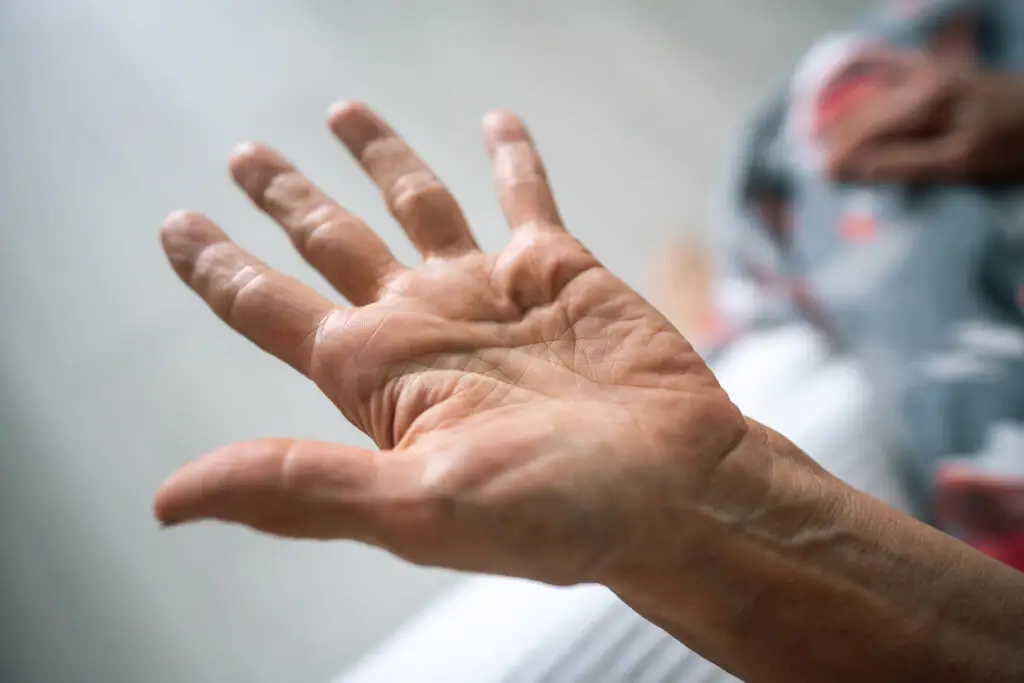
As the tightening continues, the finger may lose all its backwards movement but still be able to straighten completely. Eventually, it may no longer straighten fully and instead remain slightly bent towards the palm. This is called a contracture.
The amount of contracture is measured in degrees. A finger that can straighten fully has zero degrees of contracture, while a finger that remains bent by 20 degrees has a 20-degree contracture.
Not everyone with Dupuytren’s disease develops a contracture. Some people’s disease remains stable for years, while others experience gradual or more rapid progression.
What is the Tubiana staging system?
The Tubiana staging system was developed in the 1960s to classify the severity of Dupuytren’s contracture. It was developed in the context of surgical treatment, where the amount of finger bending is an important consideration.
The system measures how far an affected finger is from being completely straight. Where more than one joint is affected, the degrees of contracture are added together to give a total for that finger.
For example, if the joint at the base of a finger has a 20-degree contracture and the middle joint has a 15-degree contracture, the total is 35 degrees. This would be classified as Stage I.
In the original system, Stage I covered contractures from 1 to 45 degrees. However, this is a very wide range, as someone with a barely noticeable 5-degree contracture is quite different from someone whose finger is bent by 40 degrees.
This limitation became particularly important when radiotherapy began to be used to treat early Dupuytren’s disease.
The modified Tubiana staging system
A 1996 paper first authored by Ludwig Keilholz introduced an additional stage, called N/I, to distinguish very small contractures from more established disease. This was initially defined as 1–5 degrees.
In a 2001 paper, Professor Heinrich Seegenschmiedt and colleagues used a broader definition of 1–10 degrees. The modified classification is shown below.
Stage |
Degree of contracture |
What it means |
|---|---|---|
|
N |
0° |
Nodules or cords are present, but the finger can still straighten fully |
|
N/I |
1–10° |
Very slight contracture |
|
I |
11–45° |
Mild to moderate contracture |
|
II |
46–90° |
More substantial contracture |
|
III |
91–135° |
Severe contracture |
|
IV |
More than 135° |
Very severe contracture |
These stages describe the amount of contracture, rather than how active the disease is. The distinction is important because the degree of contracture alone does not determine which treatment is most suitable.
What counts as early-stage Dupuytren's disease?
For treatment purposes, one of the most important distinctions is between early and more advanced Dupuytren’s disease.
Early Dupuytren’s disease usually involves nodules or cords in the palm, with little or no finger contracture. In the modified Tubiana system, this generally corresponds to Stages N and N/I.
At this stage, the main options are monitoring or radiotherapy. Monitoring may be appropriate when the disease is stable, while radiotherapy may be considered when there is evidence that it is progressing.
More advanced Dupuytren’s disease involves greater contracture, where the finger becomes increasingly difficult to straighten. At this point, surgery or another procedure to release the tightened tissue may become more appropriate.
The distinction matters because these treatments have different aims. Radiotherapy is used to help prevent early disease from progressing, while surgery aims to correct contractures that have already developed.
Can Dupuytren's cause tightening before a contracture develops?
Yes. This is one of the important changes that the Tubiana staging system does not capture.
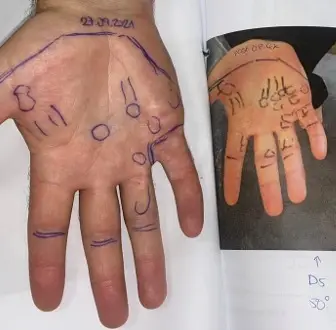
Someone may have nodules and cords in the palm and still be able to straighten their fingers fully. Under the staging system, they would be classified as Stage N, even if they have already lost some of their normal hyperextension.
For example, a finger that previously bent backwards by 20 degrees might now bend backwards by only 5 degrees. It can still straighten completely, so there is no measurable contracture, but it has lost 15 degrees of movement.
In my clinical practice, I regard this loss of hyperextension as a potentially important early sign of tightening. It may indicate that the disease is beginning to affect finger movement before a conventional contracture develops.
This is particularly relevant when considering radiotherapy, because the aim is to treat active disease before significant contracture occurs. Loss of hyperextension is one of the findings I assess when examining patients, even though it is not included in the Tubiana staging system.
Which stages of Dupuytren's can be treated with radiotherapy?
Radiotherapy is used to treat early, active Dupuytren’s disease. It aims to reduce the activity of the cells responsible for abnormal tissue growth, helping to slow or prevent further progression.
Radiotherapy will not straighten a finger that already has a substantial contracture. Its main purpose is to prevent further tightening before significant bending develops.
The best candidates are usually people with growing nodules or cords, evidence of disease progression and little or no contracture. This often means patients with Stage N or N/I disease.
However, the exact degree of contracture at which radiotherapy becomes unsuitable is not an absolute boundary.
Is 10 degrees the limit for radiotherapy?
You may see references to radiotherapy being suitable only when a contracture is less than 10 degrees. This is partly related to the modified Tubiana classification, where Stage N/I includes contractures of up to 10 degrees.
However, the staging system describes the severity of disease. It does not provide a strict cutoff for treatment.
In my practice, some patients with contractures of up to 20 degrees may still be suitable for radiotherapy. The decision depends on which joints are affected, whether the disease is actively progressing, and the nature of the nodules and cords.
Once contractures exceed 20 degrees, radiotherapy becomes less likely to be appropriate. By 30 degrees or more, assessment for a procedure to straighten the finger is generally more relevant.
These figures are guides rather than fixed rules. An individual examination is needed to determine whether radiotherapy is likely to be helpful.
When is surgery more appropriate?
As Dupuytren’s disease progresses, the cords can shorten and pull the fingers into increasingly bent positions. Once a substantial contracture has developed, radiotherapy will not correct it.
At this stage, treatment may involve surgery to release or remove the tightened tissue and improve finger straightening. Other procedures, such as needle fasciotomy, may also be suitable for some patients.
The decision to intervene depends on the degree of contracture, which joints are affected and how much the condition interferes with daily activities. A relatively small contracture may cause significant difficulties for someone who relies on precise finger movements, such as a musician, while another person with the same contracture may have few problems.
Surgery is therefore not automatically necessary simply because someone has reached a particular Tubiana stage. The decision depends on both the physical changes in the hand and their effect on the individual.
What are the limitations of Tubiana staging?
The Tubiana system provides a useful way to classify the severity of finger contracture. However, it was developed primarily to describe established deformity, and there are several important aspects of Dupuytren’s disease that it does not measure.
Nodules, cords and disease activity: The system does not measure the size or number of nodules and cords, whether they are growing, or whether the disease is actively progressing. These are particularly important considerations when assessing patients for radiotherapy.
Loss of hyperextension: A patient may have lost much of their normal backwards finger movement but still have no measurable contracture. This early tightening is not reflected in their Tubiana stage.
Which joints are affected: Tubiana staging adds together the degrees of contracture across the joints of a finger. Two patients may therefore have the same total contracture but very different patterns of joint involvement, which can affect treatment decisions.
Other aspects of hand movement: The system does not assess changes such as reduced finger span or difficulty spreading the fingers apart. These can affect hand movement without contributing to the measured contracture.
Impact on daily life: The stage does not tell us how much difficulty someone experiences using their hand. The same degree of contracture can have very different effects depending on a person’s work, hobbies and daily activities.
For these reasons, I assess each affected joint individually, alongside the nodules, cords, finger movement and evidence of progression. The Tubiana stage is a useful starting point, but it cannot replace a full clinical assessment.
Summary: what does your Dupuytren's stage mean for treatment?
Tubiana staging describes the severity of Dupuytren’s contracture by measuring how far the fingers have bent. The modified system identifies very early contractures more clearly, which is particularly helpful when considering radiotherapy.
In early disease, monitoring or radiotherapy may be appropriate, depending on whether the condition is progressing. As contractures become more advanced, surgery or another procedure to straighten the finger may become more suitable.
However, the amount of contracture is only one consideration. Loss of hyperextension, disease activity, the joints involved and the effect on everyday activities are all important when deciding whether treatment is appropriate.
If you have Dupuytren’s disease and have noticed changes in your finger movement, a specialist assessment can help establish whether monitoring, radiotherapy or another treatment is the best option for you.
References
- Tubiana R, Michon J, Thomine JM. Scheme for the assessment of deformities in Dupuytren’s disease. Surgical Clinics of North America. 1968;48(5):979–984.
- Keilholz L, Seegenschmiedt MH, Sauer R. Radiotherapy for prevention of disease progression in early-stage Dupuytren’s contracture: Initial and long-term results. International Journal of Radiation Oncology, Biology, Physics. 1996;36(4):891–897.
- Seegenschmiedt MH, Olschewski T, Guntrum F. Radiotherapy optimization in early-stage Dupuytren’s contracture: First results of a randomized clinical study. International Journal of Radiation Oncology, Biology, Physics. 2001;49(3):785–798.